


From hours to outcomes: what the pricing shift actually looks like on the ground

A month ago, I was on a call with the head of pricing at a top 20 UK firm. She told me something that's stayed with me: "We're not replacing the billable hour. We're just adding five other ways to charge on top of it."
That's the reality of legal pricing in 2026. The conversation about hourly versus fixed fees misses the point entirely. What's actually happening is messier, more interesting, and much harder to manage.
The hybrid model is already here
Much of the commentary on legal pricing treats it as a binary choice: either you bill by the hour, or you move to alternative fee arrangements. But walk into any BigLaw finance team today and you'll find something completely different.
On a single transaction, you might run hourly rates for due diligence, a capped fee with a collar for SPA negotiations, a fixed fee for completion work, and a success premium if the deal closes. That's four different pricing structures on one matter, often with the same team working across all of them.
But without the right systems, pricing these structures consistently - and knowing whether you're protecting margin - is nearly impossible.
The opportunity in alternative fees
AI is making legal work more predictable. When you can use AI to absorb scope creep, handle unexpected document volumes, or streamline due diligence, a fixed fee stops being a risk and starts being an opportunity. The efficiency gains are real. Firms need to decide who captures them - and structure pricing accordingly.
AI doesn't make all legal work equally predictable. Document review, due diligence, disclosure exercises - these are workstreams where AI and process engineering can deliver step-change improvements in speed and consistency. Other elements of the same matter - negotiations, strategic advice, novel legal questions - remain heavily dependent on senior judgement and can't be standardised in the same way.
The next wave of alternative fee arrangements isn't happening at the matter level. It's happening at the workstream level. Firms are isolating the components of work that AI has made predictable, pricing those as fixed fees, and preserving hourly billing for everything else. That way, they capture value from their technology investment without taking on unquantifiable risk.
Under hourly billing, efficiency gains belong entirely to the client - fewer hours means lower fees. Under alternative fee arrangements, firms can share in the value they create through better delivery models. If you've invested in AI, rebuilt your workflows, and can now deliver the same outcome in 60% of the time, why shouldn't some of that benefit accrue to you?
What firms actually need
But even within those AI-optimised workstreams, complex work is rarely one size fits all. A due diligence exercise on a simple acquisition with a clean data room isn't the same as one involving cross-border regulatory complications and red flags. Both are predictable enough to merit fixed pricing. But they're not the same price.
If you're running blended pricing models - and many firms now are - you need three capabilities that traditional pricing tools don't provide.
First, you need to systematise workstream-level pricing logic. When AI has made specific elements of work predictable enough for fixed fees - but those elements still vary in scope, complexity, or risk - you can't rely on partners remembering which conditions trigger which price. The pricing intelligence needs to be embedded in the system.
Second, you need a granular understanding of effort for the work that remains hourly. In the past, you could look at a precedent matter in its entirety to gauge required effort. With blended pricing, that's no longer viable. You first need to isolate the newly re-engineered workstreams, then analyse only those elements still priced by the hour. In short, you need dependable phase-level data on your precedent matters.
Third, you need transparency. When a workstream is running under a fixed fee and you're approaching the budget, the partner needs to know before it becomes a crisis. Real-time visibility into matter economics isn't a luxury anymore - it's the difference between protecting margin and writing off time.
The tools that most firms use today weren't built for hybrid pricing at scale. They can't encode conditional logic, they don't guide users through blended structures, and they certainly can't ensure consistency across hundreds of matters.
We built Ayora specifically for this problem. Our AI agent for legal matter pricing enables firms to create policies that give rise to blended fee frameworks - where selected workstreams attract a fixed price while the rest of the matter is priced on time and materials.
The magic sits in the policy layer. A firm can set multiple prices for the same workstream, with the specific value determined by conditions they define. Due diligence might be fixed at one price if the scope is straightforward, a higher price if complications arise, and a different price again if specific deliverables are required. The pricing logic captures the variables that actually drive cost and risk.
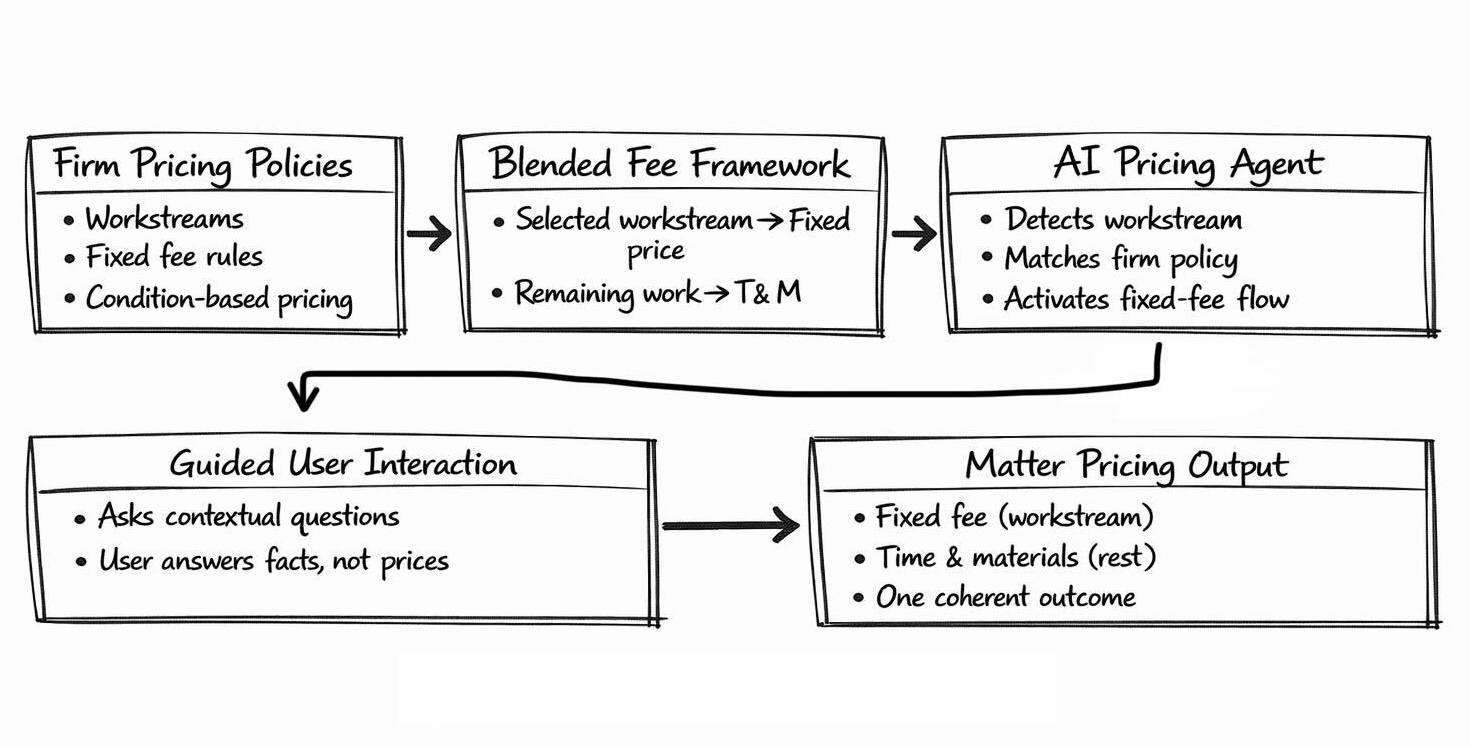
From the everyday user's perspective, this complexity is invisible. When a partner or pricing manager opens the agent, it automatically identifies that a fixed workstream policy applies, then walks them through the relevant conditions to arrive at the right price. The policy is preset. The logic is embedded. The user just answers questions and gets a quote.
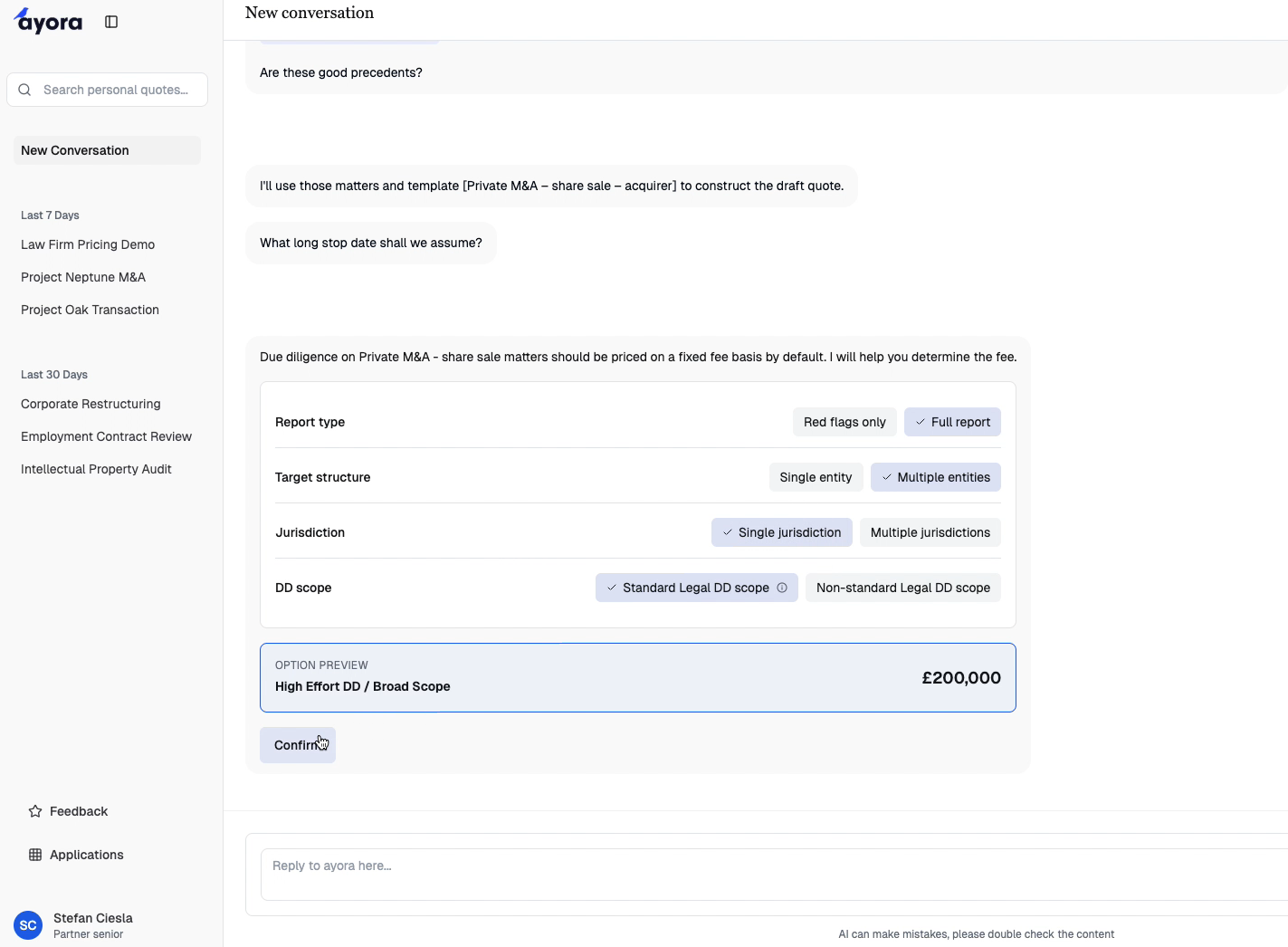
That, plus Ayora automatically (re)generates phase data within the firm's historic matters (via its AI time data enrichment capability), allowing the agent to use precedent matter data where relevant, and marry that with fixed price elements seamlessly.
What makes this powerful is that it translates institutional pricing knowledge - the kind that currently lives in a handful of experts' heads - into a system that anyone can use consistently. Firms can price blended structures with confidence, speed, and without sacrificing margin.
The opportunity for firms that move now
Clients want predictability. But they also want quality and expertise, and they'll pay for it if the value is clear. Firms that can price accurately - offering fixed fees without destroying margin, demonstrating value even on hourly work - have a competitive advantage right now. They win more pitches. They protect profitability. And they build client relationships based on trust rather than suspicion about billing.
But the window won't stay open forever. As more firms get better at this, it stops being a differentiator and starts being table stakes. The firms that are investing in pricing capabilities now are the ones that will be best positioned when the market shifts further.
What this means in practice
The shift is gradual. Keep hourly billing for now. But the firms winning work today are the ones that can price any engagement - hourly, success-based, fixed, or blended - with confidence and speed. They're not guessing. They're not managing blended pricing in spreadsheets where the logic lives in the pricing director’s head. They're using systems that encode institutional pricing knowledge, guide users through complex structures, and generate quotes that protect margin while winning clients.
The market is moving faster than most people realise. The question isn't whether alternative fee arrangements will become standard. It's whether your firm will help define how they work, or simply react to what clients demand.
