


Why alternative fee arrangements need better tools

For most of legal history, the billable hour has dominated. Partners understand it intuitively. Associates track it religiously. Clients grudgingly accept it.
Alternative Fee Arrangements are different. They involve risk, assumptions about delivery time, and commercial trade-offs that are genuinely difficult to reason about in real time. Even experienced pricing professionals find themselves working through spreadsheets, comparing scenarios, and second-guessing their calculations.
The result is predictable: AFAs remain underused, even in contexts where they would benefit both firm and client. Not because lawyers don't want to offer them, but because the tools haven't kept pace with the ambition.
We've spent the past few months rethinking how law firms should approach Alternative Fee Arrangements. The update we're releasing this month is the first step in that direction.
Making AFAs visible, not theoretical
Traditionally, AFAs appear late in the quoting process - often as an afterthought, once the time-based quote is already drafted. That creates a psychological barrier. The billable hour becomes the anchor, and everything else feels like a deviation.
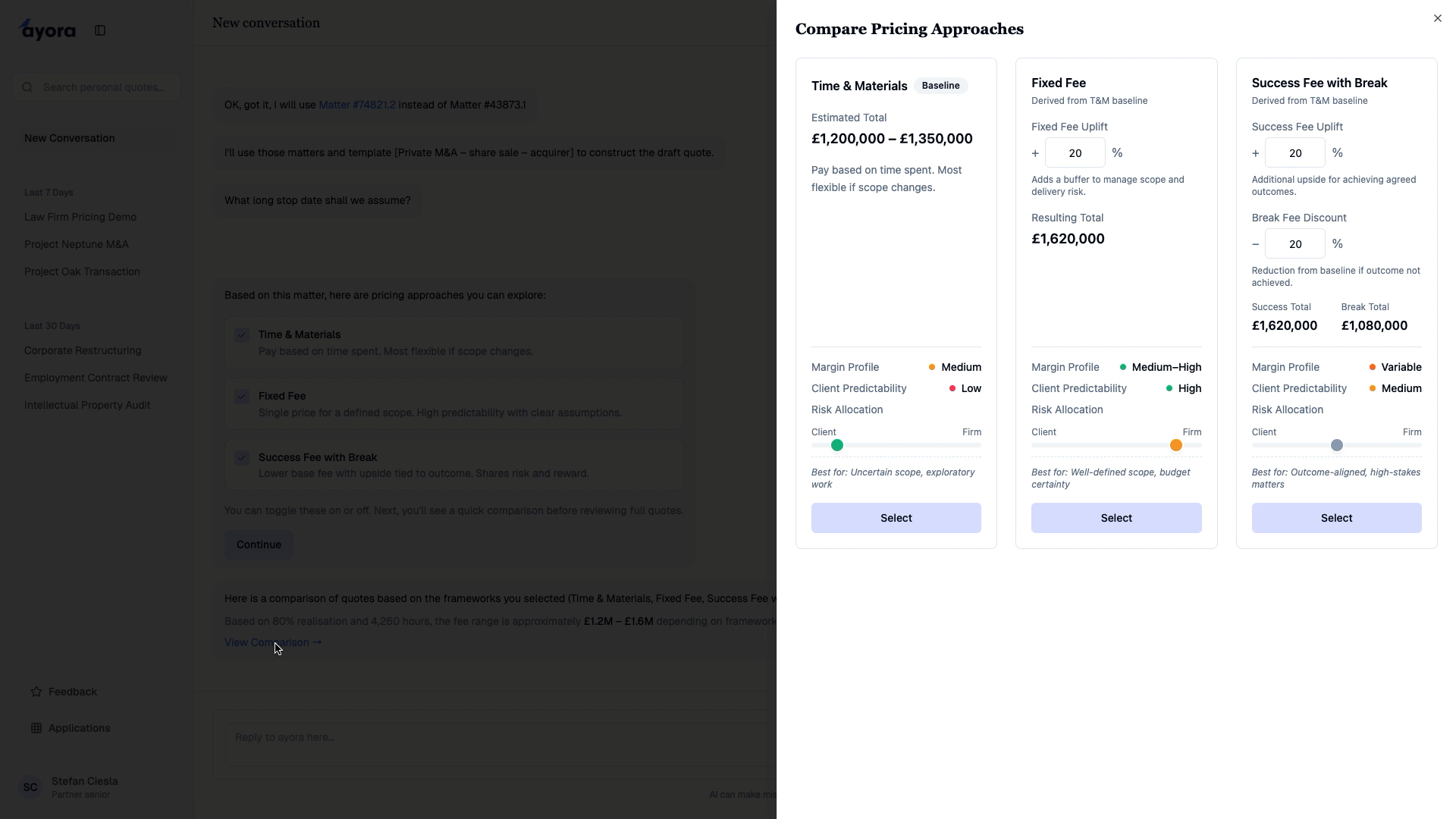
We've inverted that. The agent now introduces Alternative Fee Arrangements before presenting the draft quote, and explains the key differences between them. Lawyers can choose which AFA types they want to compare, and the system walks them through how each one works: where the risk sits, when it's appropriate, and what to watch out for.
This means lawyers don't need to be pricing experts to make a confident decision. The intelligence is baked into the workflow.
The profitability curve
Once a framework is selected, something equally important happens: we show the profitability curve.
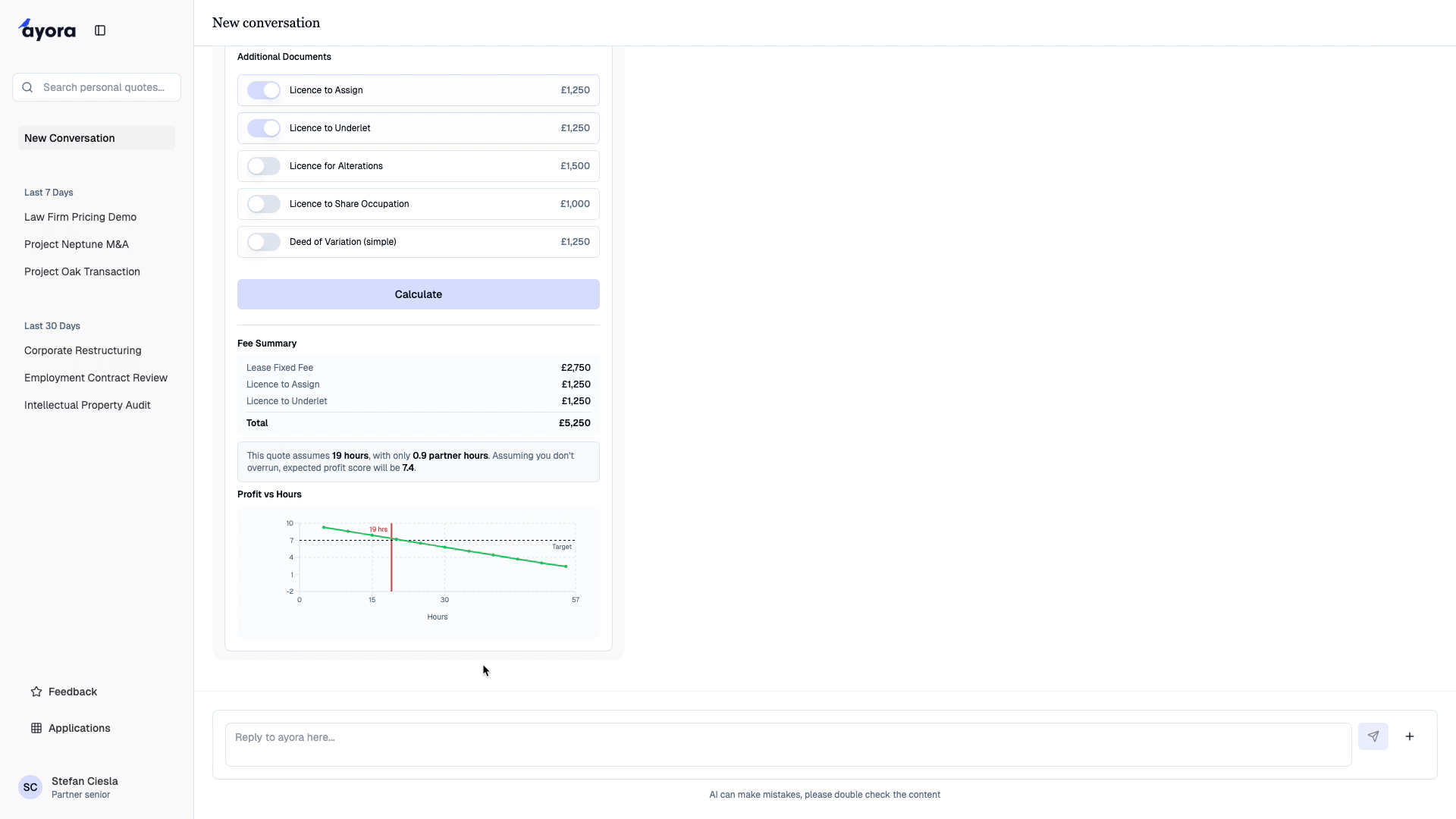
Rather than just presenting a single number, we visually model how sensitive the quote is to assumptions about delivery time - assumptions informed by our agent's analysis of precedents and expected recovery rates.
You can immediately see that different fee structures produce very different risk profiles. A fixed fee might look attractive at first glance, but if the matter runs over by 20%, the margin disappears. A success-based modifier might align incentives better.
That makes the commercial implications visible, not theoretical. And it allows lawyers to make informed choices before anything goes to the client.

Fee menus and framework agreements
The other problem we've addressed is fee menus.
In many areas - UK commercial real estate is a good example - clients already have framework agreements that dictate how they're charged. The lawyer's job isn't to create a bespoke quote from scratch; it's to apply the agreed fee menu correctly and efficiently.
If a fee menu applies in a given context, the lawyer is now presented with the relevant fee menu instead of following the precedent-based flow. They complete a structured form, and the system produces a compliant quote instantly.
Even here, we still show profitability and sensitivity to overruns and staffing. That's particularly important for smaller matters, where recovery can be damaged very easily if they're not staffed appropriately.
Customisation and hybrid arrangements
Behind the scenes, the system is highly flexible.
Modifiers can be customised to create any combination an administrator desires: a fixed fee with a success element, time and materials with a cap, or any other structure the firm uses. The interface remains simple for the lawyer, but the commercial logic underneath can be as sophisticated as needed.
We're also releasing a workstream-specific AFA feature later this month, and we'll build on that further in Q1. The goal is to support genuinely hybrid arrangements - where part of a matter is time-based, part is fixed, and part might include success fees - all within a single quote.
Why this matters now
Clients are asking for AFAs more frequently. In-house legal teams are under pressure to control costs and demonstrate value. General counsel want predictability. Procurement departments want transparency.
Law firms know this. But without the right tools, offering AFAs at scale is painfully manual. Pricing teams become bottlenecks. Partners avoid quoting AFAs because it's easier to default to the clock.
The firms that solve this - those that can offer sophisticated, profitable AFAs quickly and confidently - will have a genuine competitive advantage. Not because AFAs are new (they're not), but because most firms still can't execute them well.
What we're aiming for
Our goal is simple. We want lawyers to have the same confidence using Alternative Fee Arrangements that they've always had with the billable hour - but with much better commercial insight, and much less risk.
That means building intelligence into every step: understanding precedents, modelling profitability, showing sensitivity to assumptions, and making the trade-offs explicit.
It also means meeting lawyers where they are. Not every quote needs to be an AFA. But when an AFA is appropriate, the system should make it easy to choose the right structure, price it accurately, and present it confidently.
The billable hour isn't going away. But it's no longer the only option that feels safe. That shift - from safe to strategic - is what better tools make possible.
